Showing posts with label garden. Show all posts

Saturday, 3 May 2014

Mother's Day

Mother’s Day is just an overrated commercialized day and we don’t celebrate it our family …. Said no mother ever!

Mother’s Day is all about celebrating all the wonderful things your mum has done for you and forgetting about the things that niggle at you. Because don’t forget many of us are mothers too and I’m sure our children feel the same way if not now definitely in the future!

I heard an advert on the radio the other day that basically went like this “if your mum told you she doesn’t want a present this year, just time with you is present enough”, means you aren’t the best gift chooser and please don’t waste money on something I don’t want.

Now days it seems like we are spoilt for choice in the present department. Years ago a pot of chrysanthemums was the only choice you had for Mother’s Day. 

You know what? It’s still a darn good choice.

Chrysanthemums are traditionally given at Mother’s Day as they flower profusely during autumn and they contain the word mum! 

They are so many varieties of chrysanthemums available today; there is surely one to suit every mum. 

The US National Chrysanthemum Society has derived that there are 13 different types of flower forms and over 100 different colours.

Chrysanthemums are honestly one of the easiest plants to grow and are a perfect gift for green or brown fingered mums! Chrysanthemums have long lasting flowers and are relatively pest and disease free. 

Potted chrysanthemums can flower for several weeks indoors but thrive best if placed in full sun. They can be grown in pots or in the garden. To keep them looking fantastic and to promote more flowers all spent flowers and discoloured leaves should be removed and liquid fertilised fortnightly. After flowering chrysanthemums should be cut back to about 15cm (6") high and be given some organic link complete organic fertiliser. They can have up to three flowerings a year.

If you don’t like the traditional Chrysanthemum, Trevallan Lifestyle Centre is overflowing with living flowering gifts. Cyclamens, azaleas, pansies, anthruiums, orchids, camellias, roses are all in bloom, look fantastic and are easy to care for – even brown thumb mums should enjoy all of these! 

Team any of these plants with a beautiful planter and you have the perfect present even if your mum doesn’t have a garden. Planters are a little different from normal pots in that they don’t have a hole in the bottom. With a planter you just place the plant inside the planter, no potting. They are great for indoors as you can still give your plants a good drink without having the water running everywhere problem. Just don’t over water!

With every present you give though, don’t forget to give a little of your time as well. Even though we are adults we are still our mum’s children. She just wants the best for us – so ignore the so called mothering insanity and give her a hug and kiss and let you know you love her. Because while a mother’s love is unconditional we as children need to reassure them that our love is unconditional too!

Best Cut Flowers


I love the cooler weather. I know the days are still warm but the nights have that glorious cool tinge.

All the plants I love to surround myself with are now in bloom or coming into bloom.

I love gift giving at this time of year. I don’t do cut flowers, of course! I want my gifts to last a little longer but I also know not everyone has a green finger so I don’t want them to stress about my gift.

Which is why I always love giving
Cyclamens.

Cyclamens are the perfect indoor or shade plant for the cooler months. They have a long continuous flowering period – usually from April until October. They are available in a rich tapestry of colours ranging from white to pink, red and mauve, some are even bi-coloured. The leaves are even pretty coming in a range of shapes - from broad to rounded, kidney, or heart shaped. They may be blotched, patterned, or even marbled on the upper surface.

Cyclamens aren’t fussy which is why they are the perfect gift.

I always tell people “treat them cold keep them beautiful!”

Even though cyclamens grow fantastically indoors they love the cold; it seems to refresh and revitalise them. Every few days you should give your cyclamens a drink, wetting soil and foliage and put them outside for the night. They will appreciate the cold frosty morning!

I find just a good watering every few days is fine. I always like to place my cyclamens in a planter. Planters are a little different from normal pots in that they don’t have a hole in the bottom. With a planter you just place the plant inside the planter, no potting. They are great for indoors as you can still give your plants a good drink without having the water running everywhere problem. Just don’t over water.

Cyclamens appreciate a regular liquid fertilise. I alternate every fortnight between Triple Boost and Silica and Potash Liquid fertilisers. The Triple Boost keeps them healthy and the Silica and Potash keeps them flowering. It is a good idea to remove the spent flowers. A spent cyclamen flower should never be cut off. Instead, remove tired blooms and stems by gently twisting off at the base and pulling them away from the main tuber.

Cyclamens grow from a tuber and tend to die down during our hot humid summer. If you are lucky though and find a cool, dry, shady spot in the garden (that isn’t taken by you) they can continue to grow. If your cyclamens do die down keep them in a cool, dry, shady position and water sparingly and hope they reappear in the cool months again. If they don’t regrow think about it like this – A bunch of cut flowers that lasted over three months. Wow now that’s value for money!

A cyclamen will warm your soul even on the coldest morning. So don’t forget to spread the love this weekend.

Monday, 14 April 2014

Roses are Red


The rose has long been a source of fascination and meaningfulness for cultures around the world.

Cleopatra was believed to have covered the floor of her palace room with roses before Mark Antony visited for in those times anything which was said "under the rose" was deemed to be a secret.

For many of us Queenslanders though how to keep roses looking amazing feels like a state secret. 

I often stare in awe at the pictures in magazines of roses elsewhere in Australia. How dare they have the climatic conditions to grow these plants successfully? I suppose we can’t have everything – at least the maroons can play football!

I have never claimed to know the secrets of growing roses in a climate where for about six months of the year we have what feels like 100% humidity.

Many rose growers out there will probably have a small heart attack at my way of growing roses but that’s ok, my way is the right way for me and maybe if you’ve never had any success in the past it may become the right way for you. 

The first thing I needed to realise was that my roses may never look like they do elsewhere. The humidity we suffer is the cause of most rose problems. No amount of sprays, fertilisers or correct planting techniques will change the problems humidity brings.

To combat most of the rose problems such as black spot, fungus, bud worm that occur during the warmer months I’d trim and fertilise. 

I don’t spray. 

During the really humid months most of my roses look like bare thorny sticks. 

I find removing all the affected leaves, trimming back the plant and then fertilising with a slow release complete organic fertiliser like Organic Link works fantastically. 

I always trim my roses like I am cutting the flowers off for a long stemmed vase. I personally can’t stand long straggly bushes so I make sure all my roses get a good prune continuously throughout the year.

After pruning you can use a product like Steriprune which is designed to protect wounds against infections and die back.

Come the cooler months and my roses are thick and lush and full of flowers. 

The few leaves that do get black spot or mould just get pulled off and when the flowers die, I still trim the stem right back like I am cutting it for a long stemmed vase.

During the cooIer months I might sometimes spray with a pyrethrum based spray for insects or Searles' Rose Pro Black Spot & Insect Killer which takes care of a myriad of insects and diseases. 

My roses are in full sun in pots and in the ground.  


They get fertilised numerous times throughout the year with Organic Link and I’d try to regularly liquid fertilise them with Rose Triple Boost.
Having great roses and plants in general isn’t a state secret.
 
Which is why we are excited to have Des Warnock, our Fertiliser Guru, talking us through the ‘Secrets to a Healthy Garden, Organically’ at Trevallan Lifestyle Centre on Wednesday 30th April. Tickets are essential phone 3021 8630 for more details.
 

Wednesday, 2 April 2014

Winter Vegetables

Autumn. Warm Days, cool nights. Perfect for vegetable planting.
 
By now your vegetable patch has been freshly composted and manured. It’s just waiting for you to plant out.
The basic cool season vegetables that I find grow well in most areas are –  broccoli, beetroot (my favourite), cabbage, cauliflower, leek, onions, shallots, silverbeet, spinach, snow peas, strawberries (my other favourite), peas, kale and rhubarb. 
 
If you don’t get a frost or you can cover your vegetables - beans, lettuce, capsicum and tomatoes can also be grown.
 
If you get really cold you can give brussels sprouts a go.
This is the basic vegetable range; there are so many different variations on these classic cooler weather vegetables.
 
In seedlings alone you can get about four different versions of broccoli. 
 
If you start using old fashioned open pollinated seeds the list can be endless. 
If your vegetable patch consists of a variety of different sized pots don’t worry, there is a large range of dwarf vegetables available in seedlings and seeds. 
 
Leek, lettuce, capsicums, shallots, silverbeet, spinach, snow peas, strawberries, peas and rhubarb all grow well in pots without needing dwarf varieties.  
 
The secret to growing any vegetables in pots follows the same principles as growing in the ground. 
 
Start with the best quality soil or potting mix, mulch with an organic material (I like organic sugar cane mulch that is free from weeds), fertilise with a complete organic slow release fertiliser and liquid fertilise fortnightly with a complete organic liquid fertiliser. 
 
I like using the Plant of Health range of fertilisers – Organic Link and Triple Boost and Searles' range of garden soil and potting mix - Peat 80 Plus
I find the cooler months are the best time for growing herbs.  Nearly all the herbs are available now. Herbs grow well in the garden or in pots and most herbs can be grouped together in pots to make mini herb gardens. 
The best thing about growing cool season vegetables is that it’s usually too cold for the pests to be out and about.  If you do get a few pests a pyrethrum based spray or one of the new organic sprays like eco oil or eco fend work well.  Mildew and mould is a common problem during wet winters - copper spray (some are considered organic) can be the best solution. 
 
I have heard that having pretend white butterflies in your vegetable patch not only looks pretty but helps deter moths.
Remember though the healthier the soil, the healthier the plants and the less likely you are to get problems. Now get outside and get dirty!

Springtime Surprise

I love gardening surprises, especially when it takes no real effort on my part.

Something that always gives me great pleasure in the garden is bulbs, corms and tubers.

While I am over wishing I could have the spring display like they do in Europe or even Melbourne. I now appreciate the spring flowering bulbs that grow in my not so cold climate.

Bulbs, corms and tubers are all sometimes erroneously referred to as bulbs. The technical term for plants that form underground storage organs is geophyte.

All these types of plants cycle through vegetative and reproductive growth stages; the bulb grows to flowering size during the vegetative stage and the plant flowers during the reproductive stage.

These plants need certain conditions to trigger the transition from one stage to the next, such as the shift from a cold winter to warm spring. Due to the bulb, corm or tuber being a storage device these plants can also survive adverse conditions such as cold, excessive heat, lack of light or drought.

The foliage of these plants absorbs nutrients from the soil and energy from the sun for setting flowers for the next year.  After the foliage period is completed, bulbs can be dug up for replanting elsewhere.

If we lived in Holland, autumn is the time to plant daffodils and tulips, as they flower in spring, but here these bulbs don’t grow that well or easily.

 
Don’t despair though we can still plant some beautiful bulbs, corms, and tubers at this time of year. Lucky for us we usually have a short winter too so our spring flowering bulbs, corms and tubers are usually up and flowering before other cities.


Freesias, hyacinths, ranunculi, babiana and iris’ are all available at Trevallan Lifestyle Centre and now is the time to plant.

As you know I’m a no fuss gardener. There is probably an exact art to planting these plants but I find the easiest way is to make sure your soil is healthy and loose then plant your bulb right way up (instructions are on the packets!) and cover with soil.  Sun is necessary. I like to put a little bit of Organic Link fertilizer on top of the soil at this stage. Water the area like a normal garden – making sure it’s wet but not a bog. Once the leaf or flower starts to appear I use Triple Boost liquid fertiliser weekly. After flowering I give it a little more Organic Link to give it some nutrients to store for next season. 

Some people lift, dig up, their bulbs each year and store them until the next season. I don’t as I find I can’t store them very well and they end up dying, so I leave mine in the ground.  Sometimes I dig them up and break up the clumps so I can get more but then I usually replant them straight away.

Because bulbs and the like die down and then reappear I like them planted in amongst other plants so each year I get little flowering surprises in my garden.

Give your garden a little surprise this spring and plant some bulbs today.

Thursday, 13 March 2014

Talking Dirty

Last week on Trevallan Lifestyle Centre's Facebook page I posed the question "what gardening terms do you use that people think you've made up, don't understand or have a little giggle at your expense?"

There were some great examples given and I thought I'd enlighten you all with some gardening terms that I find I use and  people think I have started to talk in my own special language.

Deciduous
Deciduous, pronounced dih-sij-oo-uhs, is the term I am most often asked to explain. Deciduous means "falling off at maturity" or "tending to fall off", and it is typically used when talking about plants that lose their leaves seasonally. Many plants especially in cooler regions drop their leaves in autumn, have a dormant period through the winter and then come alive again in the spring. In some subtropical and arid regions plants lose their leaves during the dry season and have a dormant period until the wet season begins.

Active Constituent
Active constituents are the substance/s in an agvet (agricultural and veterinary) chemical product primarily responsible for a product's biological or other effects.
For example Glyphosate is the active constituent in most weed killers. In horticulture, companies register products with different trade names but you will often find the active constituent is the same. Trade names such as Yates Zero, Searles Dead Weed, Brunnings Weedkill all contain the same active constituent - glyphosate. When dealing with chemicals in gardening know your active constituents and you'll never have to rely on trade names again.

This next one can cause a few giggles - Bisexuality and plants
A Bisexual flower or perfect flower is when flower has both the essential whorls i.e., androecium and gynoecium (male and female reproductive units). Some examples are Lilies, Roses, Sweet Peas.

When it comes to fruit and vegetables we generally use the term bisexual plant. So the plant has male and female flowers on it. You do not need two separate plants. For example a pumpkin will usually produce both male and female flowers and then hopefully insects pollinate the females and your pumpkins grow big and strong.

Self-watering pots
Now unless you have gnomes in your garden doing all your dirty work there is no such thing as a self-watering pot. When you buy a self-watering pot you still have to water.

In a self-watering pot you have a very large saucer or water well and the soil is held above the water well with a false bottom. The water well and the soil are usually connected by a wick of some sort.

As water is used by the plant, capillary action draws more water up from below, exactly as much as is needed and no more. The soil has just the right amount of water all the time, but also maintains air pockets, which the plant roots also need. This is great for plants that don't like over watered as you just fill the bottom chamber.

While self-watering pots are great I find they only really work once the plant has an established root ball.

This weekend talk dirty with someone and show off your new gardening knowledge.

Tuesday, 18 February 2014

Bloomin' Fabulous

A common question I am asked is "why didn't my fruit trees fruit profusely or if they did why was the fruit misshapen?" Or "why didn't my camellias and azaleas flower as well this year?" Or even "why are all my coloured foliaged plants like crotons and dracaenas losing their colour?"

The answer is usually quite simple - Your garden just needs some TLC and a little Potash!

Potassium Sulphate or Sulphate of Potash is commonly called Potash.  It is an essential element necessary to the lives of all plants.

It aids in disease resistance and frost protection by strengthening the plants cell walls.  It helps in seed and root development. It encourages strong new growth and helps with the formation of flower buds and fruit.

Potash can improve the quality and the colour of flowers and enhances the formation of proteins and sugars in fruit. Potash can even help plants with slender stems and large flower heads such as Iceland poppies and gerberas hold their heads erect.

Potash defective cues can be seen in a number of ways in your plant. Your plants might be showing signs of overall weakness especially in its stem.  It could have yellowing leaf margins and grow more slowly.  It could also be disease prone and its fruit and flowers will be small and poorly coloured and sometimes tasteless.

Don't confuse a potash deficiency though with an unhealthy plant. Always make sure you have given your plant some complete slow release organic fertiliser like Organic Link first.

It seems that many Australian soils are low in potassium (potash).

Complete fertilisers, whether they are chemical or organic, usually contain potash.  Organic Link contains potash. An N:P:K ratio can usually be found on the fertiliser label. A very quick explanation of the N:P:K ratio is - N stands for Nitrogen (greening, growing), P Phosphorus (roots) and K Potassium (fruiting, flowering).

If you use mainly a manure based fertiliser like blood and bone or chicken manure you will need to add potash as these products don’t naturally contain it.

Potash also is available by itself in a liquid form and a granular form. 

The liquid form is added to water and used as a foliar spray. Used like this it is quick acting but not long lasting and needs to be repeated on a fortnightly basis. This is best for promoting flowers especially on annuals.  I use Plant of Health's Potash and Silica. 

The granular form is added to the soil and watered in.  The granular is slower acting but lasts a lot longer.  This is best for correcting deficiencies, promoting fruit and stimulating coloured foliage. We use Searles' Potash.

This weekend I want you all to get some granular potash and go a little silly in your gardens. Your winter blooming plants like camellias and azaleas will love you and your citrus trees will adore you.

Tuesday, 28 January 2014

Gardens and Unicorns

Did you make a New Year's resolution? Have you kept it?


I read a funny saying the other day about New Year's resolutions. It read "My New Years resolution is to become a unicorn". I think many of us tend to over exaggerate our expectations of ourselves. In doing this our New Years resolutions become a bit of a fantasy.


For this reason I don't make New Years resolutions anymore.
I like to say instead - I have set my intentions for the year ahead.

So if right now you had to set your intentions for year ahead, what would they be?

Would any of those intentions be green orientated?


Is this the year for that vegetable patch or to start landscaping the back yard. Maybe it's something really simple like this year I intend to start caring for my plants more.


Nothing too over the top - we don't want yards full of unicorns!


I think the first step is being honest with ourselves. So many of us don't like being wrong. I of course don't have a problem with being wrong because I'm always right......


I find my biggest hurdle in sharing gardening knowledge is asking people to be honest about their soil.


In theory we all water well and fertilise our plants. But how much of this water and fertiliser is really getting into our soils and how much is the plant really getting?


With this continued horrible heat we are experiencing our plants will dry out much sooner than we think. Plus this heat and wind has a tendency to suck any excess moisture out of the soil and foliage of the plants.


Soils can become hydrophobic so quickly and this hydrophobia can lead to unhealthy plants and sometimes even the death of a plant. Even if you think you are a great waterer - hydrophobic soil can strike anywhere, anytime. It can happen in gardens, lawns and pots.


The problem with hydrophobic soil is that it doesn't just stop water from getting to your plant it can also stop fertilisers from penetrating the soil.


While mulching and composts can help, I find the quickest and easiest way to combat hydrophobic soil is with a soil wetter.


I know I've mentioned this before but I see this being a common problem. I also know from experience what a difference soil wetters can make. I use Searles Penetraide at Trevallan Lifestyle Centre and at home. There is a granular and a liquid. I prefer the liquid, my mother and sister prefer the granules. Both do a fantastic job.


Another product I love to use in this heat is my liquid fertiliser 'Silica and Potash'.


Regular use of Silica and Potash Foliar Spray reduces heat and frost damage as well as wind burn. It improves plant growth, flowering and fruit count. It also makes plants physically tougher – tough plants are more resistant to pest and fungal attack.


This weekend get rid of the unicorns and get a healthy thriving garden instead.

Thursday, 5 December 2013

Don't Blame it on the Sunshine

What type of gardener are you?

I’m the one that has 15 minutes to spare so I’ll try to get as much done as possible. I don’t care what day, month or year it is. Things get trimmed, fertilised, sprayed and planted when I say so.  

Are you more of a follower of the rules, like only plant your sweet peas on St Patricks Day?’

Are you a seasonal gardener, only plant in the spring, trim in the summer and rest in the cooler months?

No matter what type of gardener you are does it ever feel like you are just unlucky in the garden and then once in a blue moon you hit jackpot and everything goes according to plan? Or are you always lucky and once in awhile things go astray and you just can’t explain it.

Have you ever tried to germinate seeds and sometimes you get 90% success rate and other times not one measlyseed grows yet you did nothing different?

Its not just you. It happens to everyone.

The good thing is The Jackson 5 and myself may be able to explain it.

Don’t blame it on the sunshine,
Don’t blame it on the gardener,
Don’t blame it on the good soil,
Blame it on the Moon!

For thousands of years people have been practicing Moon Planting.  

Moon planting is based on the synodic period of the Moon from one New Moon to the next, an average period of 29.5 days.
 

Over this time, farmers observed that all aspects of farming seemed to be affected by the interaction of the gravitational forces between the Sun, the Moon and Earth. The plant geeks, scientists, have found variations in sap flow, biological functions in plants and the subtle changes in Earth’s electro-magnetic fields correspond to the Moon’s gravitational pull. For us non plant geeks just as the moon influences the seas tides, it also affects the motion of water in plants and soil. The ebb and flow of this water can have an impact on seed germination, flower development and fruit production.

Ok, so how do we unlock the secrets to moon planting? With a Moon Planting Calendar of course.

Moon Planting Calendars can help unlock the secrets of the lunar cycles with easy-to-follow directions on the right time to plant, when to fertilise, when to cultivate, when to harvest and when is best to time preserve fruit.  

My grandfather swears by Thomas Zimmer’s Moon Planting calendarIt is produced in Australia for Australian conditions.

This moon planting calendar is a detailed chart that gives the correct lunar and astrological planting times forfruiting and leafy vegetables and covers the best times to weed, transplant seedlings, prune, harvest and irrigate.There are even instructions for those new to gardening by the moon.  The calendar also contains astrological information such as moon phase, equinox, solstice and eclipse dates and times, including annual planting by the moon guides as well as an astrological commentary on the year to come.

2014 - who knows what it will bring but I’m sure if you follow Thomas Zimmer Moon Calendar your garden will be bountiful. also promise when you come into Trevallan Lifestyle Centre to get your moon calendar I won’t serenade you with my Jackson 5 song!

Monday, 14 October 2013

Who am I?

Every Wednesday on Trevallan's Facebook page is "Ask it Wednesday?" A day I leave the page open to any questions the followers can throw at me and I attempt to answer them.

It's become a much anticipated day with many people tuning in to see what has been asked and of course what I've answered.

I have developed such a great personal rapport with so many of Trevallan's followers that I forget to some I am just a business on a computer screen.

This became evident when a few weeks ago on "Ask it Wednesday?" I was asked "What's my Horticultural background?"

I realised at this point that so many of you may not realise who I am - the face behind Trevallan's web presence.

I am me.

How to describe me, well first you need to know my family.

I come from a family of gardeners. My knowledge is book based but most comes from being surrounded by it all my life. It's amazing what you can learn just by listening.
My grandparents were gardeners. Their vegetable patch sustained the family, so no outside food had to be bought in apart from meat. My grandfather also loved to fiddle. His true love lay with camellias and azaleas and he self taught himself to cross breed, graft and do cuttings. He was also a lawn fanatic. Think bowling green, see my grandfathers lawn!

My parents before going into retail had a successful landscaping business 'Trevallan Landscapes' that would have been in operation for about 30 years today had my father not died in 2000. Trevallan Landscapes was high in demand and I remember my father travelling all over Queensland doing landscaping work - private and commercial. Working for him was also a great way for me to earn pocket money as I grew up.

I finished my bachelor business degree in 1999 and after my father died began working at Trevallan Lifestyle Centre full time.

Since than my pieces of paper have increased - I have a Certificate III in horticulture, am a Certified Nursery Professional, am chemcert qualified, have been a national finalist for Young Horticulturalist of year and been a HAL emerging Leader. I am also a member of the Horticultural Media Association Qld and am a committee member for local garden club 'Glebe Garden Club'.

As quickly as my pieces of paper increase so does my workload. I now write a weekly gardening column for Ipswich's local paper "The Queensland Times", I write for the gardening magazine 'About the Garden'. I write this blog, manage Trevallan's social media - Facebook, YouTube, Pinterest and this blog plus work at Trevallan. Lucky for all of us Trevallan is run by my mum who works there tirelessly so I can do all this other fun stuff! I also love giving gardening related talks to social and gardening clubs.

While I've been paper collecting so has Trevallan - over the years Trevallan has won a few awards, one I am most proud of is Best Small Garden Centre in Qld in 2010.

As many of us know knowledge isn't gained just from reading a few books. Knowledge is made up of a lifetime of asking questions and determining what you believe is right answer.
I attend as many industry run events and read as much as I can so I can try to stay onto of new information, plant releases. I also try to take the time to listen to my customers, my growers, my suppliers as I find they've tried and tested many things I wouldn't get a chance to try in my lifetime.

Basically I Live it breathe it!

But horticulture isn't my only love - aromatherapy is another passion. In between all my paper getting for horticulture I also completed - Certificate Four Massage Therapy, which included Aromatherapy I.

In October 2012 I won a world wide competition to create my own essential oil blend. This blend 'wisdom' is produced by internationally renowned aromatherapy company Perfect Potion and sold at Trevallan as well as world wide via Perfect potion stores and online trading.

Life isn't just about fertilising and sweet smells because in-between all that I'm nurturing a young family with three children six and under.

So that's me.

The girl behind the computer screen.
 

Tuesday, 17 September 2013

The Secret

I have discovered the secret to great looking plants.
 
Trace Elements.
 
Trace Elements isn’t some brand spanking new fertiliser on the block. It’s an essential item to healthy soils.
 
Most gardeners are going ‘pfft’ - I so knew that.
 
Well you might know it but how many of you use a complete trace element mix on your gardens at least once a year? What about your pots, at least twice a year?
 
It seems everyone fertilises and expects to see results. What happens when you do all the right things but you don’t see the results you want? 
A common question is – “I’ve given my plants all the TLC they can handle, I’ve fertilised, watered well, even checked the pH level and it's perfect.  What could possibly be wrong with my plants?
Trace elements.
 
Most of us are aware that plants require mineral nutrients for their growth and development. Nitrogen, phosphorus and potassium, the macro elements, the names that usually appear on fertilizer packages, whether you use organic or chemical fertilizers.  It is sometimes assumed that they are the "important" nutrients.  These macro elements are just consumed by the plants in large quantities. Trace elements, micro nutrients can often be forgotten about as they are required in minuscule quantities.
When it comes to macro elements being the most important nutrients, nothing could be further from the truth. Trace elements like Manganese, Iron, Zinc, and Copper, are every bit as vital to the plants metabolism as nitrogen, potassium and phosphorous. They have essential functions and so a deficiency in even one element will adversely affect the healthy growth of the plant. Strangely enough some trace elements when present in excessive concentrations are actually poisonous for plants.
Common gardening practices (such as liming acid soils) can contribute to widespread occurrence of micronutrient deficiencies in plants by decreasing the availability of the micronutrients present in the soil. Also, extensive use of glyphosate (most common weed killer) is increasingly suspected to impair micronutrient uptake by plants, especially with regard to manganese, iron and zinc.
So how do we pinpoint the problems in our soil? We can get a leaf or soil analysis.  Yeah right! I couldn’t be bothered with all that.
So what do I do?
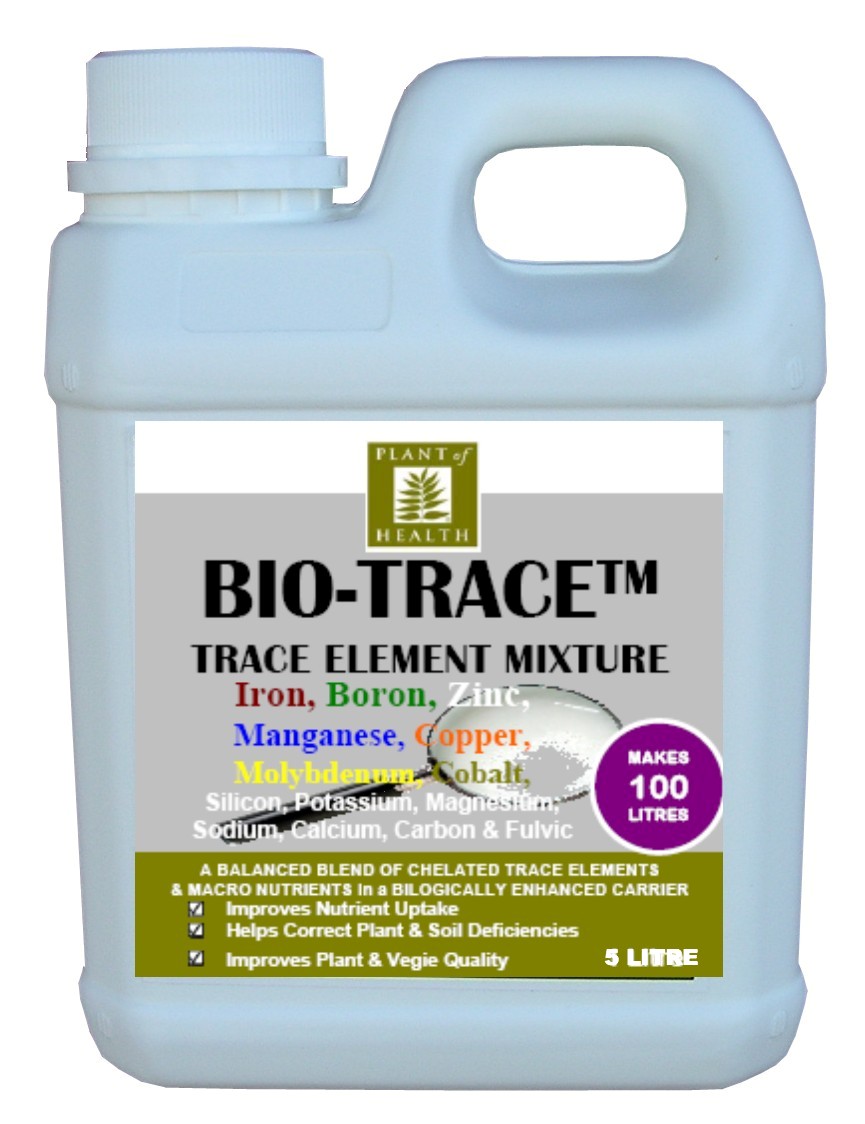
I use Plant of Health’s Bio Trace. It has a blend of the key micronutrients (e.g. iron, cobalt and manganese) supported by macro elements. It is also contains fulvic acid to further enhance growth and health.
The best thing about Plant of Health’s Bio Trace, you mix some up in a watering can and pour it over the plants foliage or as a soil drench. Done. Couldn’t have been easier.
Go on breathe some life into your garden and use Plant of Health’s Bio Trace.
Careful though, when you see the difference it makes you’ll be buying it in bulk like I do now!

 
Design by Small Bird Studios | All Rights Reserved