Showing posts with label advice. Show all posts

Saturday, 3 May 2014

Best Cut Flowers


I love the cooler weather. I know the days are still warm but the nights have that glorious cool tinge.

All the plants I love to surround myself with are now in bloom or coming into bloom.

I love gift giving at this time of year. I don’t do cut flowers, of course! I want my gifts to last a little longer but I also know not everyone has a green finger so I don’t want them to stress about my gift.

Which is why I always love giving
Cyclamens.

Cyclamens are the perfect indoor or shade plant for the cooler months. They have a long continuous flowering period – usually from April until October. They are available in a rich tapestry of colours ranging from white to pink, red and mauve, some are even bi-coloured. The leaves are even pretty coming in a range of shapes - from broad to rounded, kidney, or heart shaped. They may be blotched, patterned, or even marbled on the upper surface.

Cyclamens aren’t fussy which is why they are the perfect gift.

I always tell people “treat them cold keep them beautiful!”

Even though cyclamens grow fantastically indoors they love the cold; it seems to refresh and revitalise them. Every few days you should give your cyclamens a drink, wetting soil and foliage and put them outside for the night. They will appreciate the cold frosty morning!

I find just a good watering every few days is fine. I always like to place my cyclamens in a planter. Planters are a little different from normal pots in that they don’t have a hole in the bottom. With a planter you just place the plant inside the planter, no potting. They are great for indoors as you can still give your plants a good drink without having the water running everywhere problem. Just don’t over water.

Cyclamens appreciate a regular liquid fertilise. I alternate every fortnight between Triple Boost and Silica and Potash Liquid fertilisers. The Triple Boost keeps them healthy and the Silica and Potash keeps them flowering. It is a good idea to remove the spent flowers. A spent cyclamen flower should never be cut off. Instead, remove tired blooms and stems by gently twisting off at the base and pulling them away from the main tuber.

Cyclamens grow from a tuber and tend to die down during our hot humid summer. If you are lucky though and find a cool, dry, shady spot in the garden (that isn’t taken by you) they can continue to grow. If your cyclamens do die down keep them in a cool, dry, shady position and water sparingly and hope they reappear in the cool months again. If they don’t regrow think about it like this – A bunch of cut flowers that lasted over three months. Wow now that’s value for money!

A cyclamen will warm your soul even on the coldest morning. So don’t forget to spread the love this weekend.

Thursday, 13 March 2014

Talking Dirty

Last week on Trevallan Lifestyle Centre's Facebook page I posed the question "what gardening terms do you use that people think you've made up, don't understand or have a little giggle at your expense?"

There were some great examples given and I thought I'd enlighten you all with some gardening terms that I find I use and  people think I have started to talk in my own special language.

Deciduous
Deciduous, pronounced dih-sij-oo-uhs, is the term I am most often asked to explain. Deciduous means "falling off at maturity" or "tending to fall off", and it is typically used when talking about plants that lose their leaves seasonally. Many plants especially in cooler regions drop their leaves in autumn, have a dormant period through the winter and then come alive again in the spring. In some subtropical and arid regions plants lose their leaves during the dry season and have a dormant period until the wet season begins.

Active Constituent
Active constituents are the substance/s in an agvet (agricultural and veterinary) chemical product primarily responsible for a product's biological or other effects.
For example Glyphosate is the active constituent in most weed killers. In horticulture, companies register products with different trade names but you will often find the active constituent is the same. Trade names such as Yates Zero, Searles Dead Weed, Brunnings Weedkill all contain the same active constituent - glyphosate. When dealing with chemicals in gardening know your active constituents and you'll never have to rely on trade names again.

This next one can cause a few giggles - Bisexuality and plants
A Bisexual flower or perfect flower is when flower has both the essential whorls i.e., androecium and gynoecium (male and female reproductive units). Some examples are Lilies, Roses, Sweet Peas.

When it comes to fruit and vegetables we generally use the term bisexual plant. So the plant has male and female flowers on it. You do not need two separate plants. For example a pumpkin will usually produce both male and female flowers and then hopefully insects pollinate the females and your pumpkins grow big and strong.

Self-watering pots
Now unless you have gnomes in your garden doing all your dirty work there is no such thing as a self-watering pot. When you buy a self-watering pot you still have to water.

In a self-watering pot you have a very large saucer or water well and the soil is held above the water well with a false bottom. The water well and the soil are usually connected by a wick of some sort.

As water is used by the plant, capillary action draws more water up from below, exactly as much as is needed and no more. The soil has just the right amount of water all the time, but also maintains air pockets, which the plant roots also need. This is great for plants that don't like over watered as you just fill the bottom chamber.

While self-watering pots are great I find they only really work once the plant has an established root ball.

This weekend talk dirty with someone and show off your new gardening knowledge.

Brighten your Garden with Oranges, Yellows and Pinks.

Ixoras.

This is an I love it or I hate it plant.

My mum loves them. I must admit I verge on the opposing side. Why on earth would I write about them if they are on my not so favourite list?

Well as with many things these plants have grown on me over the years and as with many plants there seems to be a time and a place for them.

Ixoras are native to the tropical and subtropical areas throughout the world, with many of them in Tropical Asia. These plants typically can't handle frosts so if you are in a frost prone area these may not be for you. Some Ixoras are more prone to being cold affected while others can handle a little bit of cold.

Ixoras have dark green leathery leaves and produce large clusters of tiny flowers in the summer and autumn. The more common Ixoras usually have orange, gold, pink or red flowers. Ixoras prefer acidic soil and usually like a little shelter from our blazing summer sun. In saying that I have seen many gorgeous Ixoras growing in full sun and full shade.  They don't mind being in pots or the ground.

I find the four most popular Ixoras are 'Prince of Orange', 'Pink Malay', dwarf orange and dwarf gold. Ixora williamsii is also popular as it has red flowers but it really dislikes the cold so is not commonly grown in Ipswich.

Prince of Orange has fiery orange flowers and can grow around two meters tall. The dwarf orange and yellow grow to around 1/2 metre. These look amazing in pots but I have seen them in gardens  trimmed into a hedge and they look stunning when in flower. You can hardly see their green leaves.

My favourite Ixora is Pink Malay. Why do I love it? Not just because it gets covered in pink flowers but because it is so hardy. This Ixora is absolutely amazing; growing to around a metre it can handle full sun and shade. It can grow in pots or the garden and I have seen it successfully growing in a shopping centre car park. Yes that's right, a shopping centre car park. A place that has no good soil, no mulch, no care, only rain fall and it looks glorious. This is why I love this plant.

Ixoras like all my plants get fertilised with Organic Link and Triple Boost. I use Searles' Peat 80 potting mix for pots and Searles' garden soil for gardens.

There is a grub that likes to destroy your Ixora flower heads. There are a few ways to combat this - You can mix neem oil in with your fortnightly Triple Boost or I sometimes use Searles' Bug Beater. Eco-oil would also work. Sooty mould can also form on the leaves. This can be caused by scale and ants. Give your plant a really good soil drench and use a soil wetter if necessary. Fertilise and spray with Eco-oil. In a fortnight or so you should be able to hose off the soot and hopefully the ants would have dissipated.

This autumn brighten up your dull spots with shades of orange, yellow and pink.

Tuesday, 18 February 2014

Bloomin' Fabulous

A common question I am asked is "why didn't my fruit trees fruit profusely or if they did why was the fruit misshapen?" Or "why didn't my camellias and azaleas flower as well this year?" Or even "why are all my coloured foliaged plants like crotons and dracaenas losing their colour?"

The answer is usually quite simple - Your garden just needs some TLC and a little Potash!

Potassium Sulphate or Sulphate of Potash is commonly called Potash.  It is an essential element necessary to the lives of all plants.

It aids in disease resistance and frost protection by strengthening the plants cell walls.  It helps in seed and root development. It encourages strong new growth and helps with the formation of flower buds and fruit.

Potash can improve the quality and the colour of flowers and enhances the formation of proteins and sugars in fruit. Potash can even help plants with slender stems and large flower heads such as Iceland poppies and gerberas hold their heads erect.

Potash defective cues can be seen in a number of ways in your plant. Your plants might be showing signs of overall weakness especially in its stem.  It could have yellowing leaf margins and grow more slowly.  It could also be disease prone and its fruit and flowers will be small and poorly coloured and sometimes tasteless.

Don't confuse a potash deficiency though with an unhealthy plant. Always make sure you have given your plant some complete slow release organic fertiliser like Organic Link first.

It seems that many Australian soils are low in potassium (potash).

Complete fertilisers, whether they are chemical or organic, usually contain potash.  Organic Link contains potash. An N:P:K ratio can usually be found on the fertiliser label. A very quick explanation of the N:P:K ratio is - N stands for Nitrogen (greening, growing), P Phosphorus (roots) and K Potassium (fruiting, flowering).

If you use mainly a manure based fertiliser like blood and bone or chicken manure you will need to add potash as these products don’t naturally contain it.

Potash also is available by itself in a liquid form and a granular form. 

The liquid form is added to water and used as a foliar spray. Used like this it is quick acting but not long lasting and needs to be repeated on a fortnightly basis. This is best for promoting flowers especially on annuals.  I use Plant of Health's Potash and Silica. 

The granular form is added to the soil and watered in.  The granular is slower acting but lasts a lot longer.  This is best for correcting deficiencies, promoting fruit and stimulating coloured foliage. We use Searles' Potash.

This weekend I want you all to get some granular potash and go a little silly in your gardens. Your winter blooming plants like camellias and azaleas will love you and your citrus trees will adore you.

Tuesday, 17 September 2013

The Secret

I have discovered the secret to great looking plants.
 
Trace Elements.
 
Trace Elements isn’t some brand spanking new fertiliser on the block. It’s an essential item to healthy soils.
 
Most gardeners are going ‘pfft’ - I so knew that.
 
Well you might know it but how many of you use a complete trace element mix on your gardens at least once a year? What about your pots, at least twice a year?
 
It seems everyone fertilises and expects to see results. What happens when you do all the right things but you don’t see the results you want? 
A common question is – “I’ve given my plants all the TLC they can handle, I’ve fertilised, watered well, even checked the pH level and it's perfect.  What could possibly be wrong with my plants?
Trace elements.
 
Most of us are aware that plants require mineral nutrients for their growth and development. Nitrogen, phosphorus and potassium, the macro elements, the names that usually appear on fertilizer packages, whether you use organic or chemical fertilizers.  It is sometimes assumed that they are the "important" nutrients.  These macro elements are just consumed by the plants in large quantities. Trace elements, micro nutrients can often be forgotten about as they are required in minuscule quantities.
When it comes to macro elements being the most important nutrients, nothing could be further from the truth. Trace elements like Manganese, Iron, Zinc, and Copper, are every bit as vital to the plants metabolism as nitrogen, potassium and phosphorous. They have essential functions and so a deficiency in even one element will adversely affect the healthy growth of the plant. Strangely enough some trace elements when present in excessive concentrations are actually poisonous for plants.
Common gardening practices (such as liming acid soils) can contribute to widespread occurrence of micronutrient deficiencies in plants by decreasing the availability of the micronutrients present in the soil. Also, extensive use of glyphosate (most common weed killer) is increasingly suspected to impair micronutrient uptake by plants, especially with regard to manganese, iron and zinc.
So how do we pinpoint the problems in our soil? We can get a leaf or soil analysis.  Yeah right! I couldn’t be bothered with all that.
So what do I do?
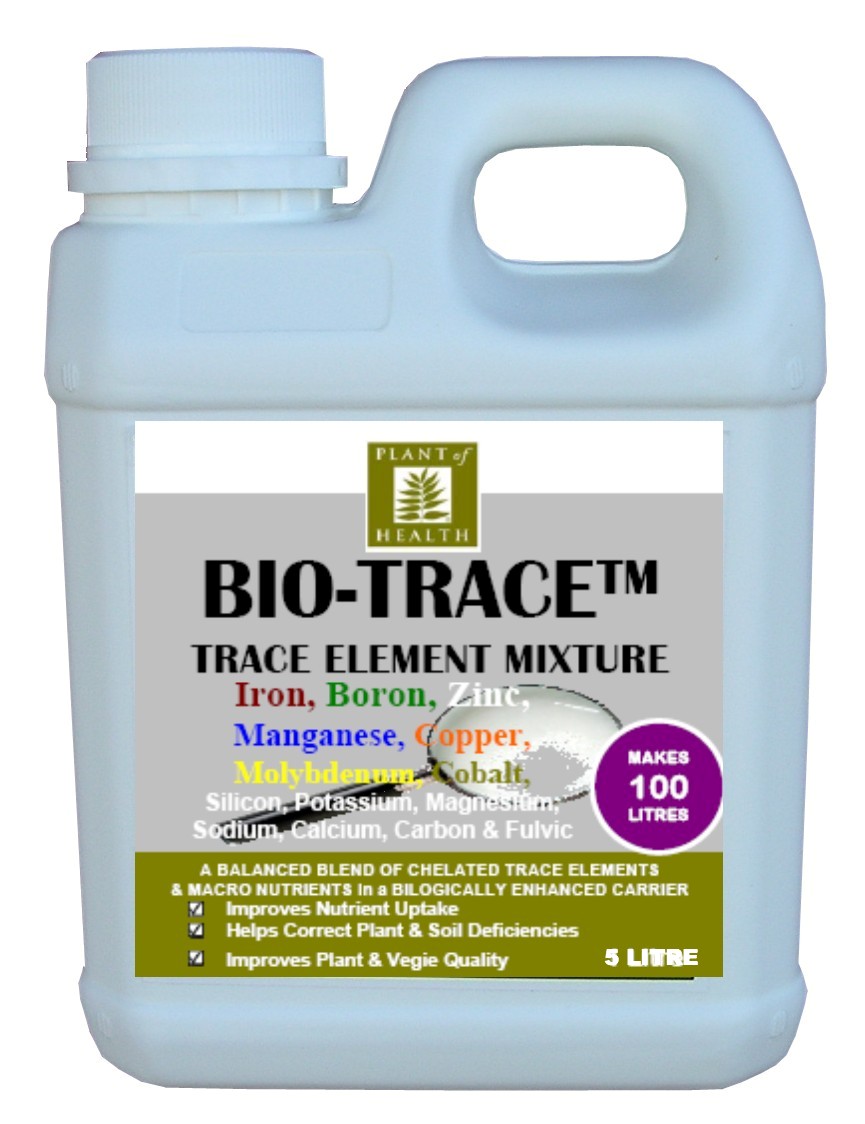
I use Plant of Health’s Bio Trace. It has a blend of the key micronutrients (e.g. iron, cobalt and manganese) supported by macro elements. It is also contains fulvic acid to further enhance growth and health.
The best thing about Plant of Health’s Bio Trace, you mix some up in a watering can and pour it over the plants foliage or as a soil drench. Done. Couldn’t have been easier.
Go on breathe some life into your garden and use Plant of Health’s Bio Trace.
Careful though, when you see the difference it makes you’ll be buying it in bulk like I do now!

Saturday, 28 January 2012

Got Milk

Why is it so hard just to buy milk? You all know the advert on TV with the guy who just wants milk but the shop assistant rattles off about twenty different choices. All he wants is milk that tastes like milk! In the end the relief on his face when the shop assistant just gives him what he wants is priceless.
I’m not a huge fan of being overloaded on choice.  Electronic equipment, like computers and their programs, is one area where I’d rather there is no choice just a simple answer.  I’m not a person that likes to spend hours trolling the internet and magazines looking for the best computer program for my needs. I appreciate going to a specialist computer shop, talking to an expert and them recommending me the best program for my needs.
I feel the same about gardening.  Gardening shouldn’t be hard – back breaking maybe but not hard. Getting good gardening advice shouldn’t be confusing either.   If you have a problem with your plants, need some general gardening advice or even just need to buy a living gift, I recommend you go to a specialist garden centre as they have expert staff on hand at all times ready to help.
Have you ever been confused and overloaded by the choice of gardening products on the market, I know I do sometimes.  I often wonder just how many versions of trace element mix can there be!  Every gardening magazine, lifestyle show and the guy next door all have their favourite gardening tips. 
If confusion and past not so ‘good tips and helpful hints’ have stopped you enjoying the great outdoors, it’s time to take control and visit an expert – your local garden centre, like Trevallan Lifestyle Centre.


Your local garden centre’s staff are the gardening experts – they should be able to listen to your needs and recommend the right product. Good garden centres shouldn’t need to offer a large choice especially in insecticides and pesticides. You don’t need to know that there are ten brands on the market that kill slugs and are safe for dogs.  You just need one and one that works. So a garden centre need only stock the one brand that they as experts perceive is the best.  Sometimes a small range of similar products (for example potting mixes)  is necessary as people’s needs are different. The garden centre’s experts should then be able to inform you of the differences and recommend the best one suited to your needs.
Your local garden centre is not only staffed by experts but those experts are usually local and have all suffered the same gardening problems that you are currently suffering.  Garden centre staff enjoy helping you through your gardening problems, taking the confusion away and giving you back the joy of gardening.
Next time you decide to improve your plant life balance and give your life some TLC make sure you visit the gardening experts - Trevallan Lifestyle Centre - your local garden centre.

 
Design by Small Bird Studios | All Rights Reserved