


I
have discovered the secret to great looking plants.
Trace
Elements.
Trace
Elements isn’t some brand spanking new fertiliser on the block. It’s an
essential item to healthy soils.
Most
gardeners are going ‘pfft’ - I so knew that.
Well
you might know it but how many of you use a complete trace element mix on your
gardens at least once a year? What about your pots, at least twice a year?
It
seems everyone fertilises and expects to see results. What happens when you do
all the right things but you don’t see the results you want?
A
common question is – “I’ve given my plants all the TLC they can handle, I’ve fertilised,
watered well, even checked the pH level and it's perfect. What could possibly be wrong with my plants?
Trace elements.
Most
of us are aware that plants require mineral nutrients for their growth and
development. Nitrogen, phosphorus and potassium, the macro elements, the names
that usually appear on fertilizer packages, whether you use organic or chemical
fertilizers. It is sometimes assumed
that they are the "important" nutrients. These macro elements are just consumed by the
plants in large quantities. Trace elements, micro nutrients can often be
forgotten about as they are required in minuscule quantities.
When
it comes to macro elements being the most important nutrients, nothing could be
further from the truth. Trace elements like Manganese, Iron, Zinc, and Copper,
are every bit as vital to the plants metabolism as nitrogen, potassium and phosphorous.
They have essential functions and so a deficiency in even one element will
adversely affect the healthy growth of the plant. Strangely enough some trace
elements when present in excessive concentrations are actually poisonous for
plants.
Common gardening
practices (such as liming acid soils) can contribute to widespread occurrence
of micronutrient deficiencies in plants by decreasing the availability of the
micronutrients present in the soil. Also, extensive use of glyphosate (most
common weed killer) is increasingly suspected to impair micronutrient uptake by
plants, especially with regard to manganese, iron and zinc.
 So
how do we pinpoint the problems in our soil? We can get a leaf or soil analysis.
Yeah right! I couldn’t be bothered with
all that.
So
how do we pinpoint the problems in our soil? We can get a leaf or soil analysis.
Yeah right! I couldn’t be bothered with
all that.
So
what do I do?
I
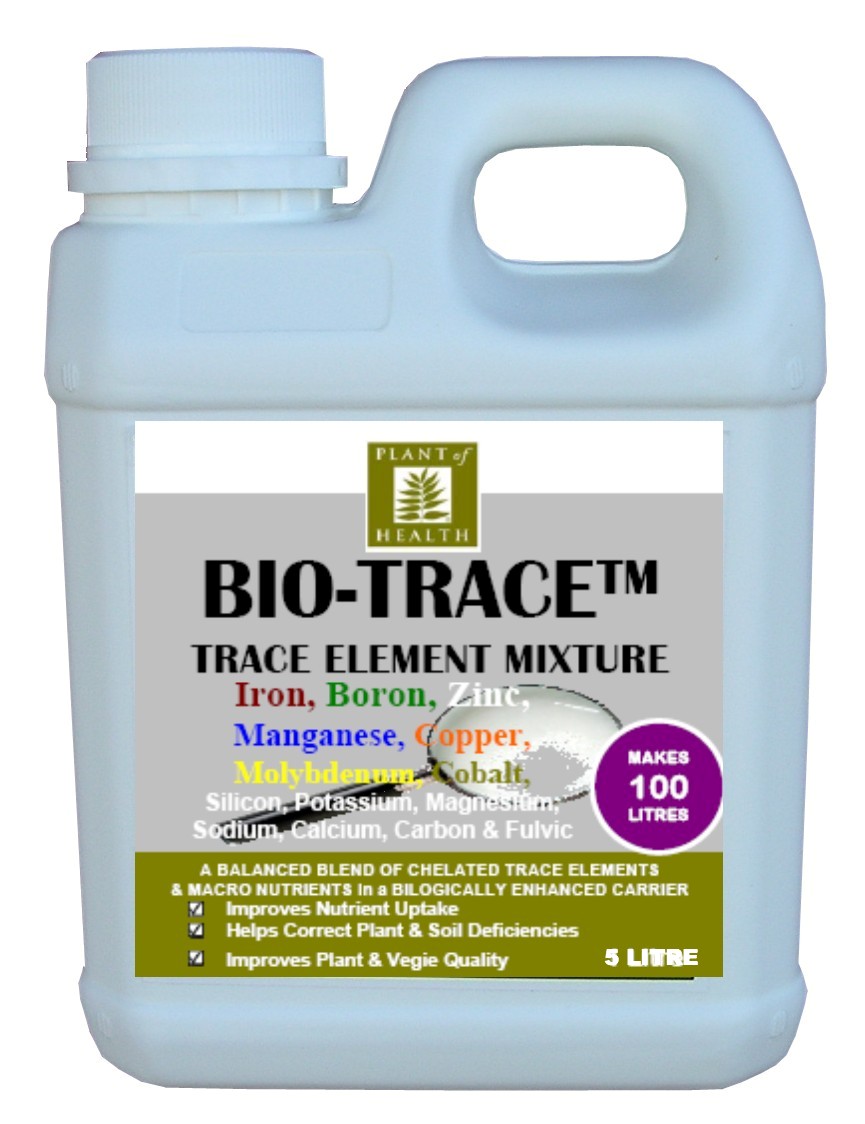
use Plant of Health’s Bio Trace. It has a blend of the key micronutrients (e.g.
iron, cobalt
and manganese) supported by macro elements.
It is also contains fulvic acid to further enhance growth
and health.
The
best thing about Plant of Health’s Bio Trace, you mix some up in a watering can
and pour it over the plants foliage or as a soil drench. Done. Couldn’t have
been easier.
Go
on breathe some life into your garden and use Plant of Health’s Bio Trace.
Careful
though, when you see the difference it makes you’ll be buying it in bulk like I
do now!


